
Manufactured Flex RangeQ-Flex Range
A low-voltage power factor correction and filter bank solution that cuts utility costs, frees up capacity and controls harmonics.
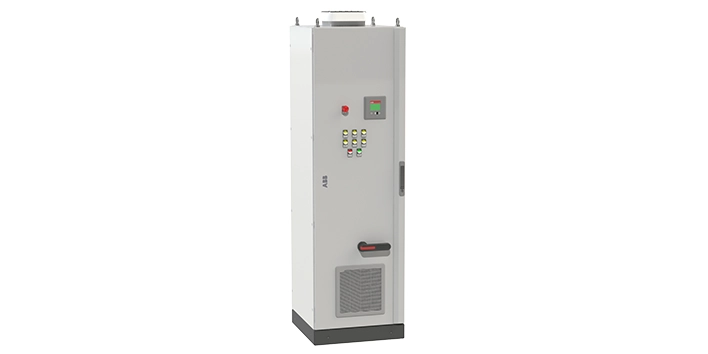
A modular capacitor bank built on Hitachi QCap capacitors and ABB RVC/RVT controllers, from 380 to 690 V, 50 Hz. Up to 400 kVAr in a single floor-standing cubicle (1200 kVAr across multiple cabinets), with 7%–12.5% detuned reactor options for harmonic-rich installations. Engineered and assembled by PPE Technologies.

Built around cost and power qualityCorrect the power factor, cut the cost
Q-Flex is designed to improve the way electrical power is used across an installation, supporting a more efficient and stable network as demand changes. Its configurable approach allows power quality requirements to be addressed as part of the wider electrical system, creating a strong foundation for reliable day-to-day operation.
Lower bills, more capacity
Correcting power factor reduces demand charges and system losses, frees up capacity on transformers and cables, and improves voltage across the plant.
Modular, expandable design
Floor-standing or wall-mounted cubicles that scale by adding cabinets — up to 400 kVAr per cubicle and 1200 kVAr across multiple cabinets.
Harmonic-ready
Detuned reactor options (7%–12.5%) protect the capacitors and help keep total harmonic distortion within the 5% IEC guideline in harmonic-rich installations.
SMARTER POWER. BETTER EFFICIENCY.Q-Flex — Power Factor Correction Engineered to Perform
Q-Flex is PPE Technologies’ flexible Low Voltage Power Factor Correction and filter bank solution, designed to improve energy efficiency, manage harmonics and reduce unnecessary electrical demand.
Built for industrial and commercial applications, its modular design allows the system to be configured and expanded according to the needs of the installation.
Typical project environmentsWhere Q-Flex can be positioned
Q-Flex can be applied wherever changing electrical loads place added demand on the wider power network. Its adaptable design allows the solution to be positioned across different operating environments, helping support more consistent system performance as site requirements evolve.
Industrial plants
Power factor correction for motor- and transformer-heavy loads to cut demand charges and system losses.
Harmonic-rich installations
Detuned filter banks for sites with VSDs, rectifiers, UPS and other non-linear loads.
Commercial & infrastructure
Compact wall-mounted or floor-standing correction for commercial buildings and infrastructure.
Utilities & generation
Reduce reactive loading on generators, transformers and distribution lines.
Technical overviewA practical view of power quality
Q-Flex is developed to work as part of the wider electrical network, where load behaviour and system conditions influence the final solution. The overview alongside introduces the main engineering considerations that shape how the system is configured for a specific installation.
Product category
Low-voltage power factor correction and filter bank solution (modular capacitor bank)
Configuration
380–690 V, 50 Hz; up to 400 kVAr per floor-standing cubicle, 1200 kVAr across multiple cabinets; 0%, 7% or 12.5% detuned; floor-standing (2000 × 700 × 600 mm) or wall-mounted (800 × 700 × 300 mm)
Protection & control
ABB RVC (standard) or RVT (enhanced) controller; miniature circuit breaker, contactor switching and fuse protection with optional isolator; Hitachi QCap capacitors that self-decommission at end of life
Interfaces
RVT controller with Ethernet, USB and RS-485 Modbus; up to eight temperature probes; PLC/SCADA monitoring
Manufacturing
Engineered and assembled by PPE Technologies with Hitachi QCap capacitors to IEC 61921 and IEC 61439-2
Project support
Design coordination, harmonic assessment, installation support, commissioning and lifecycle services
Documentation
Project drawings, test records, operating information and supporting product documents
Product resourcesExplore the Q-Flex resources
Take a closer look at the thinking behind Q-Flex and how it fits into broader power-quality planning. The supporting resources below add useful context for understanding the solution, its engineering approach and its role within different electrical environments.
Read More
Measurement context for electrical records
Electrical records may describe a value as instantaneous, averaged, or recorded over a defined interval. An instantaneous reading represents one point in time; an average combines readings across a period; and an interval record preserves how a measured quantity changes during that period. Keeping these descriptors with the value prevents a single observation from being mistaken for a time-series record.
RMS, or root mean square, is a mathematical method for expressing the equivalent heating value of a varying electrical waveform. It is distinct from a peak value, which records the greatest excursion, and from an average value, which depends on the averaging method and time window.
Three-phase notation in electrical records
In three-phase documentation, line-to-line notation refers to a measurement taken between two phase conductors, while line-to-neutral notation refers to a measurement between one phase conductor and the neutral reference. The two notations describe different measurement points and should not be compared as though they were the same quantity.
Phase sequence is the order in which the three phase waveforms reach their corresponding positions in a cycle. It is a property of the phase arrangement recorded for a system, separate from the numerical magnitude of a measurement. Recording the measurement point and phase notation alongside a value makes the electrical record more precise.

Q-Flex Flyer
A concise introduction to Q-Flex, highlighting its purpose and role within power factor correction and power quality systems.
Q-Flex Brochure
A more detailed overview of Q-Flex, with added context around configuration, system performance and application requirements.

Request project information
Start an application-specific conversation with the PPE Technologies team.
Discuss Your Q-Flex Requirement
Share your voltage, kVAr requirement, load information and available drawings with PPE Technologies for an initial engineering discussion about power-factor correction or harmonic-filter-bank requirements.